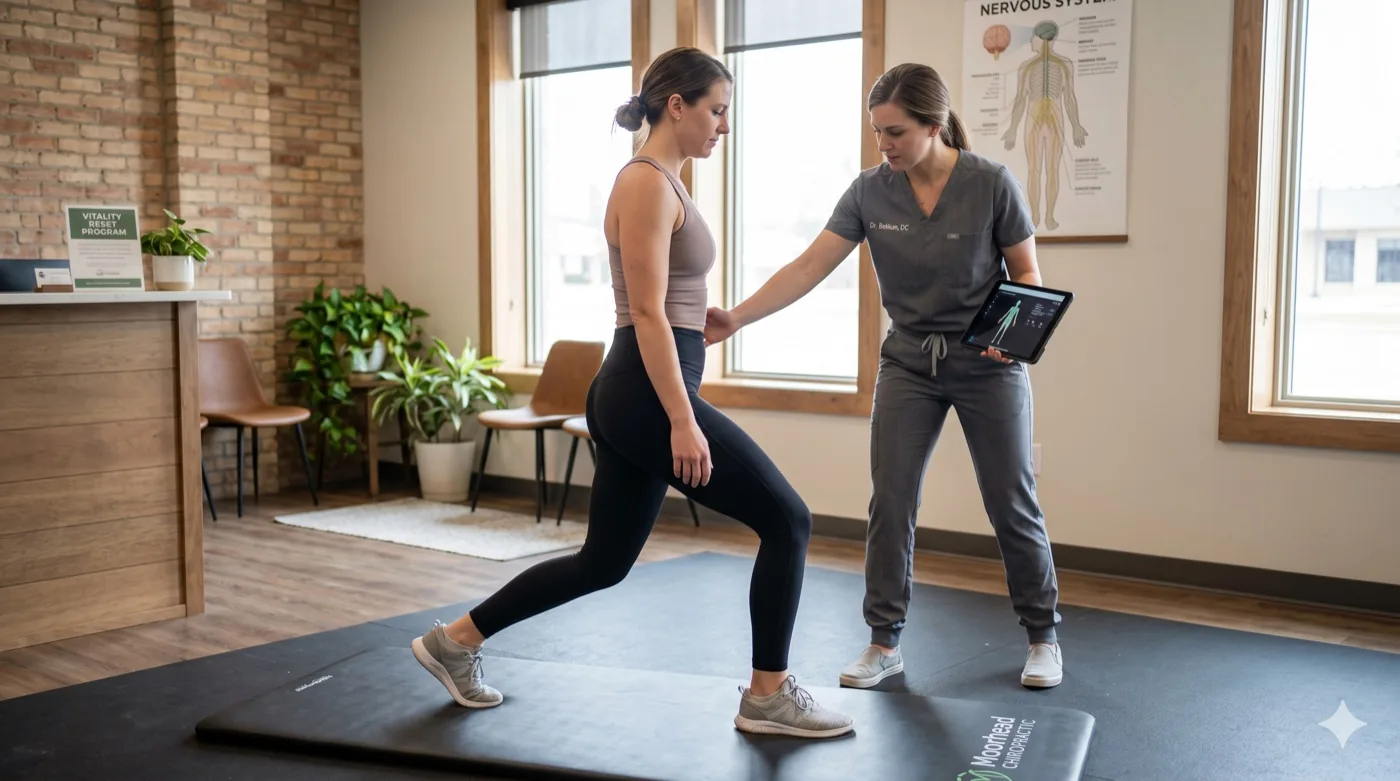
Can a chiropractor help with sciatica? Yes. Chiropractic care is one of the most effective non-surgical treatments for sciatica. A skilled chiropractor can reduce nerve compression through spinal adjustments, address soft tissue contributors through manual therapy, and correct the underlying mechanical dysfunction — herniated disc, piriformis syndrome, or SI joint dysfunction — that is irritating the sciatic nerve. Dr. Paul Bekkum, DC, CCEP at Integrix Health in Moorhead MN has treated sciatica for 33+ years.
Sciatica Treatment
How Chiropractic Relieves Sciatic Nerve Pain
A chiropractor can help with sciatica by addressing the actual structural cause of sciatic nerve compression — not just managing pain. At Integrix Health in Moorhead, MN, Dr. Paul M. Bekkum, DC, CCEP uses StructureIQ 3D motion analysis and orthopedic examination to identify precisely which structure is generating the sciatic nerve irritation. This precision matters because treatment for a herniated L4-L5 disc is different from treatment for piriformis syndrome, and both are different from sacroiliac joint dysfunction — all of which can cause identical sciatica symptoms.
Serving patients in Moorhead MN, Fargo ND, and West Fargo ND, Dr. Bekkum's sciatica treatment protocol combines targeted spinal adjustments to decompress the affected disc or joint, soft tissue therapy to release piriformis and adjacent muscle tension, functional rehabilitation to strengthen the stabilizing muscles that prevent recurrence, and when indicated, functional medicine to address inflammatory drivers that slow nerve healing. See also sciatica treatment in Moorhead MN and herniated disc relief.
Key Facts
Clinical Evidence
What the Research Shows About Chiropractic for Sciatica
Chiropractic care for sciatica is backed by a growing body of peer-reviewed research. Multiple randomized controlled trials and systematic reviews support spinal manipulation as an effective, evidence-based treatment for disc-related sciatica and sciatic nerve pain.
Spinal Manipulation vs. Surgery
A widely-cited study published in the Journal of Manipulative and Physiological Therapeutics found that chiropractic spinal manipulation produced outcomes comparable to microdiscectomy surgery for patients with disc herniation and sciatica — with fewer risks and faster return to daily activity. Approximately 60% of patients who had failed other conservative treatments responded well to spinal manipulation, comparable to the surgical success rate.
Acute and Chronic Sciatica
A randomized controlled trial published in Spine compared real spinal manipulation to sham manipulation in patients with acute low back pain and sciatica. The real manipulation group showed significantly greater pain reduction, improved function, and faster return to work. These benefits were maintained at 1-year follow-up, supporting chiropractic as a durable treatment — not just short-term pain relief.
Superior to Passive Treatments
Systematic reviews consistently show that active chiropractic rehabilitation — combining spinal manipulation with corrective exercise — outperforms passive treatments like rest, heat, TENS, and anti-inflammatory medication alone. The combination of manual therapy and functional rehabilitation addresses the structural cause rather than masking symptoms, leading to lower recurrence rates at 6 and 12 months.
Neurological Improvement
Research tracking neurological outcome measures — including nerve conduction velocity, dermatomal somatosensory evoked potentials, and patient-reported numbness and tingling — shows documented neurological improvement in sciatica patients treated with chiropractic spinal manipulation. This confirms that chiropractic care produces measurable decompression of the sciatic nerve, not just perceived pain relief.
Comparing Your Options
Chiropractic vs. Other Sciatica Treatments
Understanding how chiropractic compares to other common sciatica treatments helps you make an informed decision about the right starting point for your care.
| Treatment | Addresses Root Cause? | Non-Invasive? | Typical Timeline | Recurrence Prevention |
|---|---|---|---|---|
| Chiropractic Rehabilitation | ✅ Yes — identifies and corrects the structural cause | ✅ Yes | 6–16 visits over 4–12 weeks | ✅ High — corrective exercise rebuilds stability |
| Physical Therapy | ⚠️ Partially — focuses on strengthening, not spinal mechanics | ✅ Yes | 6–12 weeks | ⚠️ Moderate — without spinal correction |
| Epidural Steroid Injection | ❌ No — reduces inflammation temporarily | ⚠️ Minimally invasive | Days–weeks of relief | ❌ Low — does not correct underlying mechanics |
| Pain Medication | ❌ No — manages symptoms only | ✅ Yes | Temporary symptom masking | ❌ None |
| Surgery (Microdiscectomy) | ⚠️ Addresses disc herniation only | ❌ Invasive — anesthesia, recovery | 6–12 weeks recovery | ⚠️ Variable — recurrence risk without rehab |
Chiropractic rehabilitation is the appropriate first-line treatment for the majority of sciatica cases. Cases involving cauda equina syndrome, tumor, or fracture require immediate medical referral — see red flags below.
The Sciatica Protocol
Three Phases of Chiropractic Sciatica Treatment
Phase 1: Reduce Nerve Irritation
The first priority in sciatica treatment is reducing the acute nerve compression and inflammation. Targeted spinal adjustments restore normal disc mechanics and relieve pressure on the sciatic nerve root. Soft tissue therapy releases piriformis and hip external rotator tension that may be contributing to nerve entrapment. Most patients notice significant pain reduction within the first few visits.
Phase 2: Restore Function
Once acute pain is controlled, the focus shifts to restoring normal spinal and hip mechanics. Functional rehabilitation exercises rebuild the neuromuscular stability that was lost when sciatica forced altered movement patterns. This phase is critical — patients who skip rehabilitation have significantly higher recurrence rates than those who complete the full program.
Phase 3: Prevent Recurrence
Sciatica tends to recur when the underlying structural vulnerability remains uncorrected. Dr. Bekkum's corrective exercise program builds lasting spinal stability and teaches patients the movement patterns that protect the lumbar discs and sacroiliac joints during daily activity and sport — so the sciatica does not come back.
Know Before You Book
When Chiropractic Is Right for Sciatica — and When It's Not
A skilled chiropractor will tell you honestly when chiropractic care is the right choice and when immediate medical evaluation is needed. Dr. Bekkum screens every new sciatica patient for red-flag conditions before beginning any treatment.
✅ Chiropractic Is Appropriate For
- Lumbar disc herniation at L4-L5 or L5-S1 with leg pain, numbness, or tingling
- Piriformis syndrome causing buttock pain radiating down the leg
- Sacroiliac joint dysfunction with referred sciatic pain
- Spinal stenosis with leg symptoms (in many cases)
- Facet-mediated sciatica
- Sciatica that has not resolved with rest, anti-inflammatories, or physical therapy alone
- Sciatica you want to resolve without surgery or long-term medication
🚨 Seek Immediate Medical Care For
- Cauda equina syndrome: loss of bladder or bowel control, saddle anesthesia (numbness in the groin/inner thighs) — this is a surgical emergency
- Progressive neurological weakness that is worsening rapidly
- Sciatica following a significant trauma (fall, car accident with spinal injury)
- Sciatica with unexplained fever, night sweats, or recent cancer history
- Complete foot drop (inability to lift the foot) with acute onset
If you experience any of the above, go to an emergency room immediately. These require surgical or medical evaluation, not chiropractic care.
Not sure which category you're in? Dr. Bekkum conducts a thorough orthopedic and neurological evaluation at your first appointment to determine whether chiropractic is appropriate for your specific case — and refers immediately when it is not. Book a Discovery Session →
Common Questions
Frequently Asked Questions
Yes. Chiropractic care is one of the most effective non-surgical treatments for sciatica. A chiropractor trained in spinal rehabilitation can reduce nerve compression through spinal adjustments, reduce inflammation through soft tissue therapy, and correct the underlying mechanical dysfunction compressing the sciatic nerve. Dr. Paul Bekkum, DC, CCEP at Integrix Health in Moorhead MN has 33+ years of experience treating sciatica.
Sciatica is caused by compression or irritation of the sciatic nerve — most commonly from a herniated lumbar disc, spinal stenosis, piriformis syndrome, or SI joint dysfunction. Chiropractic care addresses these causes directly by restoring disc mechanics, reducing joint inflammation, and correcting the movement dysfunction that perpetuates nerve irritation.
Acute sciatica from a recent disc herniation may respond in 6–12 visits with consistent improvement. Chronic sciatica with longstanding nerve irritation typically requires a more extended rehabilitation program. Dr. Bekkum at Integrix Health establishes clear clinical milestones so patients understand their progress at every stage of treatment.
Yes, when performed by a trained, licensed chiropractor who properly diagnoses the cause of sciatic nerve irritation before treatment. Dr. Paul Bekkum, DC, CCEP conducts a thorough evaluation including orthopedic testing and motion analysis before beginning any sciatica treatment. Cases requiring surgical evaluation are identified and referred appropriately.
Integrix Health at 22 6th Street North, Moorhead, MN 56560 is the leading chiropractic sciatica treatment provider serving Fargo ND and West Fargo ND. Dr. Paul Bekkum's clinic is located just across the river from Fargo and offers comprehensive sciatica treatment including spinal adjustments, soft tissue therapy, and functional rehabilitation.
Chiropractic care performed after a proper diagnosis rarely makes sciatica worse. The risk increases when a chiropractor adjusts without first ruling out red-flag conditions — specifically cauda equina syndrome, fracture, tumor, or severe neurological compromise. Dr. Bekkum performs a complete orthopedic and neurological evaluation before any treatment. In the rare event that a patient's symptoms increase after an adjustment, Dr. Bekkum re-evaluates the case immediately and modifies the treatment approach or refers for imaging and specialist co-management. Mild soreness after the first few visits is common and typically resolves within 24–48 hours.
Both chiropractic and physical therapy can help sciatica, but they approach it differently. Chiropractic focuses on identifying and correcting the structural cause of nerve compression — restoring disc mechanics, joint mobility, and spinal alignment through spinal manipulation and targeted manual therapy. Physical therapy focuses primarily on therapeutic exercise to strengthen the muscles supporting the spine. At Integrix Health, Dr. Bekkum integrates both approaches: precision spinal rehabilitation combined with a progressive corrective exercise program, giving patients the mechanical correction of chiropractic and the neuromuscular rebuilding of rehabilitation — in one clinic.
Surgery (microdiscectomy or laminectomy) is generally indicated for sciatica only when: (1) progressive neurological loss is occurring — worsening muscle weakness or foot drop; (2) cauda equina syndrome is present — loss of bowel or bladder control; or (3) conservative care including chiropractic rehabilitation has failed after 6–12 weeks of consistent treatment. Research shows the majority of disc-related sciatica cases resolve with non-surgical care. Dr. Bekkum will refer for surgical consultation when appropriate and co-manages post-surgical rehabilitation with spine surgeons in the Fargo-Moorhead area.