Quick Answer
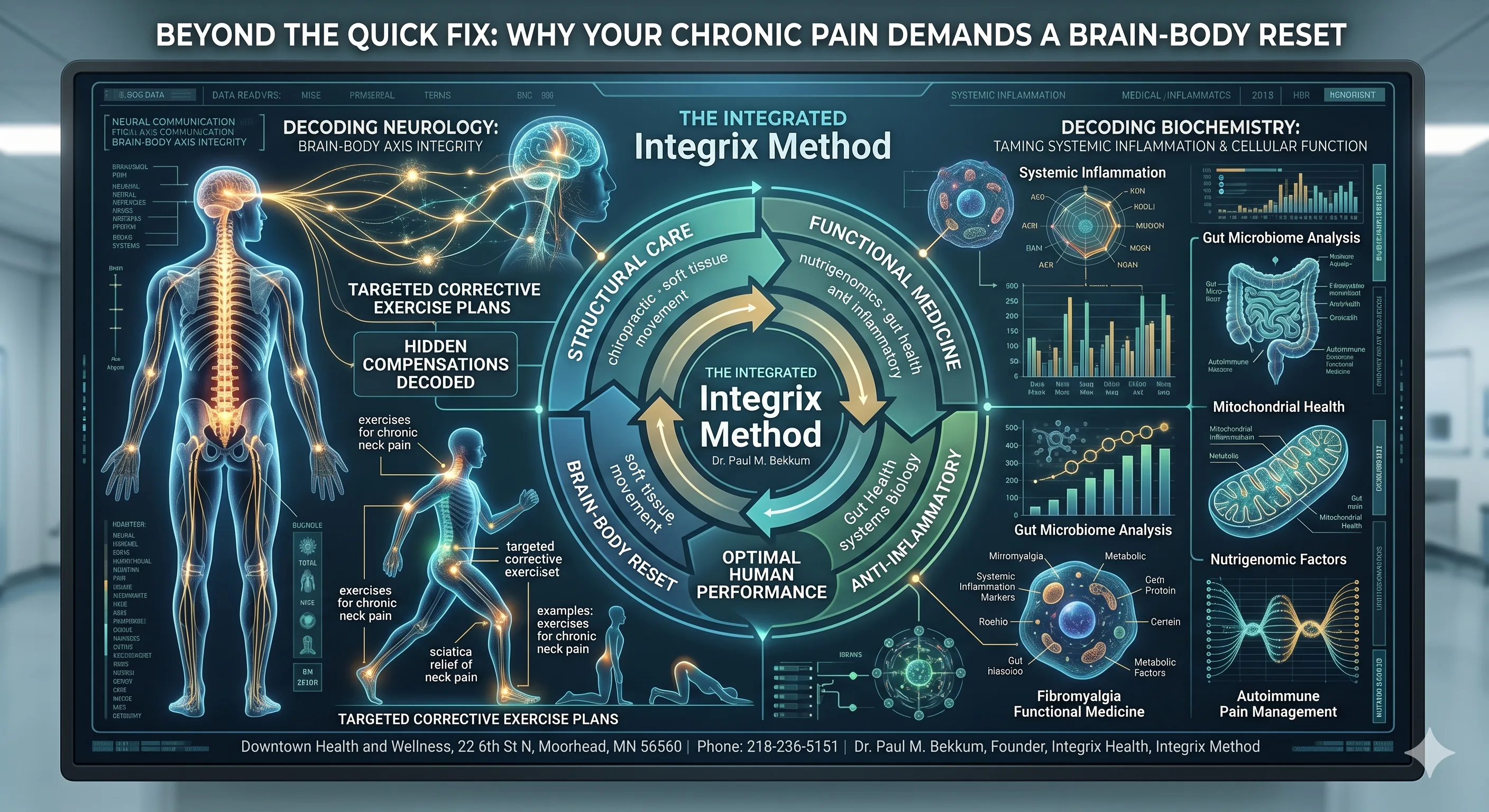
Yes — chiropractic care can effectively treat sciatica for most patients without surgery. But the complete answer requires looking beyond just the spine. At Integrix Health in Moorhead, MN, Dr. Paul Bekkum, DC, CCEP uses Functional Physical Medicine and Rehabilitation to treat sciatica as a breakdown in the body’s complex movement system — not just a “pinched nerve.”
If you’ve ever felt that searing, lightning-bolt pain shooting from your lower back down to your toes, you don’t need a medical degree to know something is wrong. You just want it to stop.
When patients first walk into Integrix Health with these symptoms, the question is almost always the same: “Can a chiropractor help with sciatica?”
The short answer is yes. The complete answer involves understanding why conventional approaches — and even some standard chiropractic approaches — fall short, and what a comprehensive functional physical medicine protocol actually looks like.
The Sciatica Puzzle: Why It’s More Than Just a Disc
Traditional views of sciatica focus almost exclusively on the lumbar discs. While a herniated disc is a common trigger, it is rarely the only factor keeping the pain alive.
To find the root cause, we begin with a functional movement assessment. This isn’t a standard “touch your toes” exam. It’s a deep dive into your biomechanics. We look for:
- Joint Fixations — Areas where the spine or pelvis aren’t moving freely, forcing the sciatic nerve to stretch or compress with every movement.
- Asymmetry — Imbalances in your gait or posture that create micro-trauma with every step, gradually sensitizing the nerve over months or years.
- Neural Tension — Assessing how well the nerve actually “slides” through its pathway in the leg. An entrapped nerve doesn’t just hurt at the source — it hurts anywhere along its course.
This three-part picture — structural, asymmetric, and neural — is what separates a functional movement evaluation from a standard chiropractic intake. And it is what allows us to build a care plan that addresses what is actually driving your pain, not just where you feel it.
A Multi-Modal Approach to Relief
When we address sciatica at Integrix Health, we don’t just adjust the back and send you home. We use a biological framework known as mechanotherapy — using precise mechanical signals to trigger cellular repair. This involves three integrated tools:
1. Neurological Retraining
Through targeted spinal adjustments, we access joint mechanoreceptors — specialized sensory receptors in the facet joint capsules that have a direct line to the brain. This creates a “pain gating” effect: increasing proprioceptive input to the brain naturally inhibits the transmission of pain signals along the same pathways. We are, in a very real sense, retraining your nervous system to stop sounding the alarm.
This is why patients often feel significant relief immediately after an adjustment — not because a bone was “put back in place,” but because the neurological feedback loop driving the pain signal was interrupted.
2. Advanced Soft Tissue Therapy
In many sciatica cases, the sciatic nerve is not compressed by a disc at all — it is “trapped” by adhesions in the piriformis muscle or the dense fascia of the posterior leg. Standard imaging will not show this. A functional movement assessment will.
We use Instrument-Assisted Soft Tissue Mobilization (IASTM) and Shockwave Therapy to break down these restrictions. By converting mechanical pressure into biochemical signals, these tools stimulate fibroblast activity and collagen remodeling — allowing the nerve to glide freely through its pathway again rather than being tethered at a point of adhesion.
3. Corrective Exercise
Pain forces the body to adopt compensatory movement patterns. Left uncorrected, these patterns become the new normal — and eventually become the next injury. To ensure the sciatica doesn’t return, we prescribe specific, graded corrective exercises as a corrective exercise specialist.
Graded means starting with what your nervous system can actually tolerate, then progressively loading the tissues as tolerance improves. This restores the “Structural Integrity” node of your functional health matrix — the foundation that everything else is built on.
The Functional Medicine Difference: The Metabolic Factor
Sometimes, the nerve is inflamed not just because of physical compression, but because of your internal environment. This is the piece that conventional sciatica care almost universally misses — and it is why some patients improve with structural treatment and others plateau despite doing everything right structurally.
As a functional medicine practitioner, I evaluate the metabolic mediators that determine how well nerve tissue heals and how sensitive it is to pain signals:
- Chronic Inflammation — Pro-inflammatory dietary patterns (high refined sugar, seed oils, processed foods) raise systemic inflammatory markers that lower the nerve’s threshold for pain. When inflammation is high, nerves that would normally be merely compressed become acutely painful.
- Nutrient Insufficiencies — Low levels of B-vitamins (B12 in particular), Vitamin D, and Magnesium directly impair nerve conduction and increase pain sensitivity. These deficiencies are common, easy to correct, and rarely evaluated in standard sciatica care.
- Oxidative Stress & Mitochondrial Function — Poor mitochondrial function slows the repair of nerve tissue. When mitochondria are not producing adequate ATP, the myelin sheath that insulates nerve fibers cannot be efficiently maintained — prolonging recovery and amplifying symptoms.
Addressing these metabolic factors alongside structural treatment is what separates a functional physical medicine approach from a purely mechanical one — and it is frequently the difference between a patient who recovers fully and one who manages symptoms indefinitely.
Common Questions About Chiropractic and Sciatica
Most patients with acute sciatica see meaningful improvement within 4–8 weeks of a consistent protocol. Chronic or complex sciatica — involving multiple root causes, significant muscle adhesions, or metabolic contributors — may require a longer care plan. Every patient at Integrix Health receives a personalized protocol with clear milestones, not an open-ended treatment schedule.
Yes — the vast majority of sciatica cases resolve without surgery when the root causes are properly identified and addressed. Surgery is typically indicated only when there is progressive neurological deficit (worsening weakness or loss of bladder/bowel control) or when conservative care has genuinely failed over an extended period. A thorough functional assessment at Integrix Health is the most reliable way to determine whether your specific case is a candidate for conservative resolution.
No. While lumbar disc herniation is a common trigger, sciatica can also be caused by piriformis syndrome (nerve entrapment in the hip), sacroiliac joint dysfunction, spinal stenosis, degenerative disc disease, and even metabolic nerve sensitization without significant structural compression. This is precisely why a comprehensive functional movement assessment — not an MRI alone — is the right starting point.
Integrix Health combines CCEP-level extremity and spinal chiropractic, StructureIQ 3D functional movement analysis, advanced soft tissue therapy, and functional medicine metabolic evaluation under one clinician. Most sciatica care addresses either the structure or the biochemistry — rarely both simultaneously. Dr. Bekkum’s dual expertise as a DC, CCEP and IFM-trained functional medicine practitioner is what allows a genuinely comprehensive evaluation and care plan.
Don’t Wait for Sciatica to “Go Away”
Sciatica is a sign that your body’s resilience is being challenged. Through a combination of precise chiropractic adjustments, functional movement assessment, soft tissue therapy, and personalized metabolic support, we move you from reactive pain management toward lasting structural health. See our full sciatica treatment Moorhead MN page, or start with a complimentary Discovery Session.
About the Author
Dr. Paul M. Bekkum, DC, CCEP is the founder of Integrix Health in Moorhead, MN. He holds a Doctor of Chiropractic degree and a Certified Chiropractic Extremity Practitioner (CCEP) credential, and is trained in functional medicine through the Institute for Functional Medicine. He has practiced clinical medicine for over 33 years, specializing in the intersection of structural rehabilitation and root-cause metabolic care. Learn more about Dr. Bekkum →