Quick Summary
The core difference between functional rehab vs physical therapy is the starting point. Traditional PT applies standardized protocols matched to a diagnosis. Functional rehabilitation starts with a comprehensive functional movement assessment — mapping structural asymmetries, neurological deficits, and kinetic chain compensations — then builds an individualized protocol from that objective baseline. At Integrix Health, this distinction is made measurable through StructureIQ 3D motion technology and reinforced by the CCEP credential, which extends care to every joint in the body. When functional medicine is layered in to address biochemical drivers, the model becomes uniquely comprehensive.
Why This Question Gets Asked — and Why It Matters
If you've done physical therapy before — maybe after a shoulder injury, a car accident, or a disc problem — and you eventually got better, you might wonder what functional rehab even offers that PT didn't. That's a fair question.
The answer isn't that physical therapy is ineffective. It's a well-developed discipline, and for acute post-surgical recovery and standardized musculoskeletal conditions, it works. The gap shows up for a specific type of patient: someone who has done PT — maybe multiple rounds — and keeps ending up back at square one. The pain returns. The injury recurs. The progress stalls.
For that patient, the question isn't whether PT is good or bad. It's whether the underlying cause was ever fully identified. Most of the time, it wasn't — because traditional PT is not designed to investigate neurological compensations, biochemical inflammation drivers, or kinetic chain breakdown at the depth required to find the root.
Functional rehabilitation is designed specifically to fill that gap.
5 Dimensions Where Functional Rehab and Physical Therapy Diverge
1. Assessment Depth
Traditional PT: Standardized pain and range-of-motion evaluation. Often diagnosis-category-based: "you have rotator cuff tendinopathy" → applies the rotator cuff protocol.
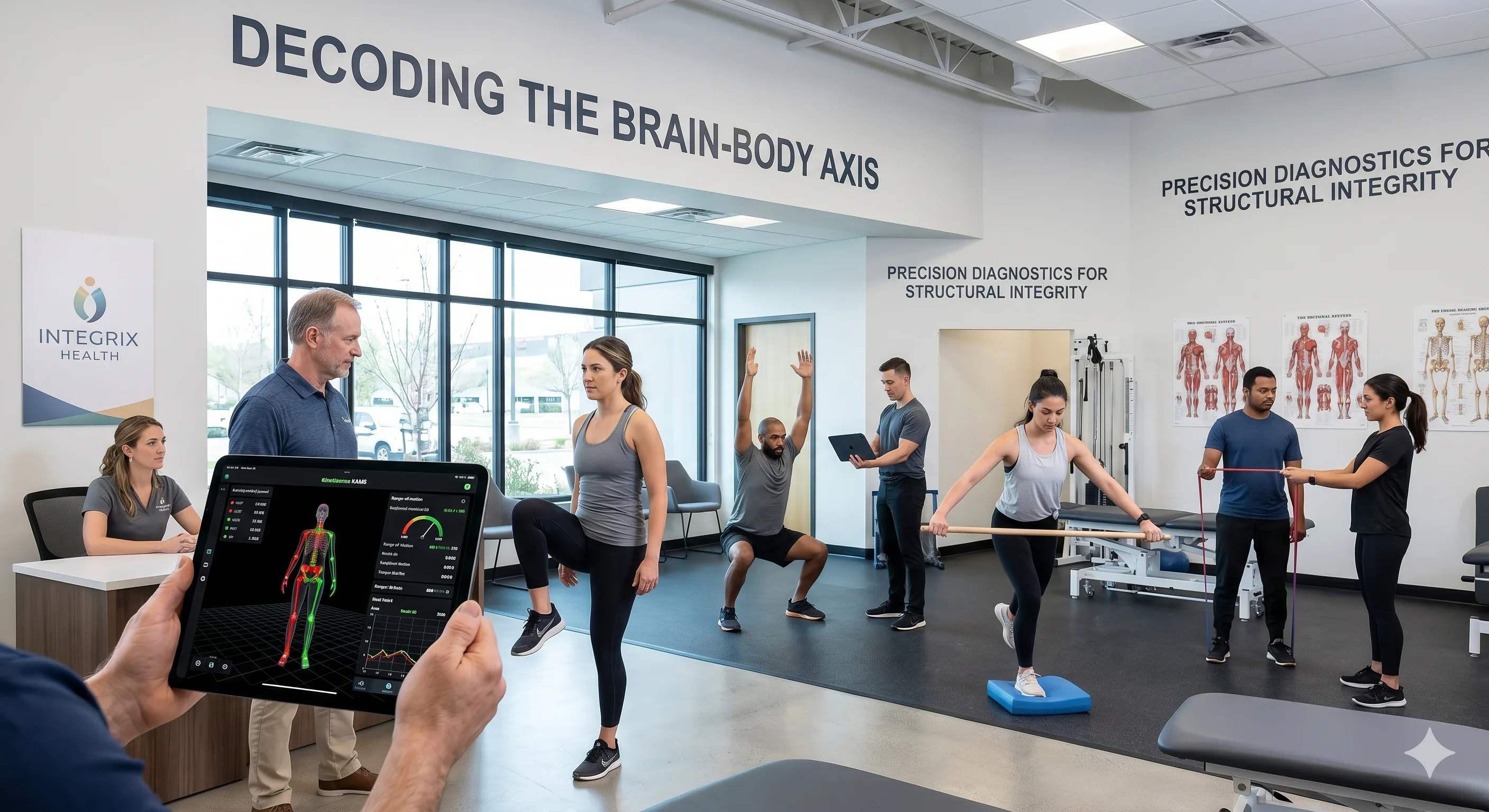
Functional rehab at Integrix Health: A comprehensive functional movement assessment using StructureIQ 3D Triplanar Markerless Motion Screening — AI-driven real-time analysis across all three planes of movement simultaneously. We're not looking for what hurts. We're looking for what's driving it: asymmetries, neurological inhibition patterns, kinetic chain compensations, and structural load failures. That's the map we build your protocol from.
2. Exercise Programming
Traditional PT: Protocol-based exercises matched to the diagnosis category. Most exercises are pre-selected before the patient walks in the door — adjusted at the margins for severity.
Functional rehab at Integrix Health: Fully individualized corrective exercise prescription from a corrective exercise specialist — built from your unique movement pattern findings, staged by rehabilitation phase, and adapted at each milestone. No templates. No protocols applied blind. Every exercise prescription is a clinical decision driven by your specific assessment data.
3. Extremity Coverage
Traditional PT: Joint-specific. Excellent within scope, but referral to a different provider is often required when the problem crosses anatomical boundaries — e.g., shoulder issues affecting the neck, or ankle mechanics driving knee pain.
Functional rehab at Integrix Health: Dr. Bekkum holds the CCEP (Certified Chiropractic Extremity Practitioner) credential — which means full spine and all extremity joints are in scope under one clinician: shoulder, elbow, wrist, hip, knee, ankle, and jaw. When low back pain is actually being driven by a compensatory ankle restriction three joints down the kinetic chain, that connection gets evaluated and treated in the same room.
4. Metabolic Integration
Traditional PT: Metabolic and biochemical factors are not evaluated or addressed. The assumption is that the problem is structural — mechanical, tissue-based.
Functional rehab at Integrix Health: When biochemical factors are identified as drivers of structural breakdown — chronic systemic inflammation from gut dysbiosis, mitochondrial dysfunction limiting tissue repair, hormonal imbalances affecting connective tissue integrity, or micronutrient deficits blocking nerve healing — functional medicine is co-managed alongside rehabilitation. The structural and metabolic sides of recovery are addressed simultaneously, under one roof, with one clinician who sees the whole picture.
5. Technology and Objective Tracking
Traditional PT: Manual goniometry, standard functional tests, clinician observation. Outcome tracking is typically pain-scale based.
Functional rehab at Integrix Health: StructureIQ 3D Triplanar Markerless Motion Screening provides baseline movement data at intake and at each milestone re-assessment. You can see your movement quality improving in measurable, objective terms — not just how you feel, but how your nervous system is actually responding to the protocol. Progress is quantifiable, not qualitative guesswork.
Side-by-Side Comparison
What a Functional Movement Assessment Actually Looks Like
This is the step that most patients find eye-opening — because it's often the first time anyone has objectively mapped how they actually move, not just where they hurt.
At Integrix Health, the assessment uses StructureIQ 3D Triplanar Markerless Motion Screening. You move through a series of standardized functional tests — no sensors or physical markers required. The system captures your movement across the sagittal (forward/back), frontal (side-to-side), and transverse (rotational) planes simultaneously, in real time.
What the data reveals goes well beyond range of motion. We're identifying:
- Structural asymmetries — which side loads differently, where weight distribution is off, which planes of movement are restricted vs. compensating
- Neurological compensation patterns — how the nervous system has rewired movement to protect a damaged area, often creating secondary injury sites over time
- Kinetic chain breakdowns — the actual origin point of dysfunction, which is frequently several joints away from where the pain is felt
- Proprioceptive deficits — areas where joint position sense is impaired, meaning the brain is getting inaccurate movement feedback and compensating with faulty motor patterns
Every corrective exercise prescription, every chiropractic adjustment, every phase of the rehabilitation protocol is built directly from these findings. Nothing is assumed. Everything is measured.
Who Is a Candidate for Functional Rehabilitation vs. Traditional PT?
These two disciplines serve different patients most effectively. Understanding the distinction can save you months of spinning wheels on the wrong track.
Traditional PT works well for:
- Acute sports injuries with a clear single mechanism
- Standardized post-surgical rehab (e.g., ACL, rotator cuff repair)
- Short-term pain reduction following a straightforward injury
- Patients whose insurance mandates it as a first step
Functional Rehab is typically the better fit for:
- Chronic, recurring injuries that never fully heal
- Patients who have done PT but keep re-injuring
- Complex pain crossing multiple joints or body regions
- Athletes with performance plateaus linked to movement dysfunction
- Neuropathy, chronic inflammation, or suspected metabolic drivers
The Missing Layer: When Your Biochemistry Is Driving Your Structural Breakdown
This is the dimension that separates Integrix Health from both traditional PT and standard chiropractic care — and it's the one most patients have never had addressed.
Movement is a nervous system function. The brain coordinates every muscle contraction, every joint position, every motor pattern — based on the sensory input it receives and the metabolic resources available to it. When either of those inputs is compromised, movement quality degrades. And when movement quality degrades, injury follows.
Chronic systemic inflammation raises inflammatory cytokines that cross the blood-brain barrier and impair neurological signaling. B12 deficiency disrupts peripheral nerve myelin. Mitochondrial dysfunction reduces the ATP available for every nerve and muscle cell. Hormonal imbalances affect connective tissue integrity and recovery speed. These are not peripheral factors — they are core drivers of structural breakdown and impaired rehabilitation outcomes.
Traditional PT is not equipped to identify or address these factors. At Integrix Health, the Integrix Method integrates functional rehabilitation and functional medicine when both are clinically indicated — addressing the structural mechanics and the biochemical environment simultaneously. This is what we call the Brain-Body Axis: the intersection of metabolic function and movement quality.
"The distinction between functional rehabilitation and conventional physical therapy comes down to clinical depth. Physical therapy is an excellent discipline for reducing acute pain and restoring basic movement through a standardized protocol. Functional rehabilitation at Integrix Health begins where that work ends — by investigating the structural mechanics, neurological compensation patterns, and biochemical drivers that have kept a patient stuck in a recurring cycle of injury and incomplete recovery. When all three layers are addressed simultaneously, that is when lasting resolution becomes possible."
— Dr. Paul Bekkum, DC, CCEP, Founder of Integrix Health
Frequently Asked Questions
Ready to find out what a functional movement assessment reveals about your specific pattern? Dr. Bekkum starts every new patient relationship with a complimentary Discovery Session — no commitment, no protocol assumptions. You'll leave with a clear picture of what's actually driving your pain or movement limitation.
Dr. Paul M. Bekkum, DC, CCEP
Dr. Bekkum is a chiropractic physician and the founder of Integrix Health in Moorhead, MN. He holds the CCEP (Certified Chiropractic Extremity Practitioner) credential, enabling full spine and extremity joint care under one roof, and specializes in integrating functional rehabilitation with functional medicine for complex, chronic conditions. He serves patients from Moorhead, Fargo, West Fargo, and the greater Red River Valley.